Searches for the best IPTV service are common, and most of the answers are lists written to sell. This page takes a different approach. It explains how to judge any IPTV service on the points that matter, so you can test options yourself. It also explains why this site does not publish a ranked list yet.
The short answer
There is no single best IPTV service for everyone. The right choice depends on the device you use, the speed and stability of your connection, and the channels you need. A service that suits one household can be a poor fit for another. The most useful answer is a method you can apply, so start there.
Why we publish the method, not a list
A list of services is only as good as the testing behind it. Testing a service properly takes time across several days, at peak hours, on the devices real viewers use. We have not yet completed that testing for a list, and we will not publish scores or rankings we cannot back up. Doing so would be the kind of unverified claim this site is built to avoid.
This site does not sell subscriptions, and it takes no fee for placing any service. When we do publish a comparison, it will show the test method and the weights, so you can disagree with them.
How to judge a service: five criteria
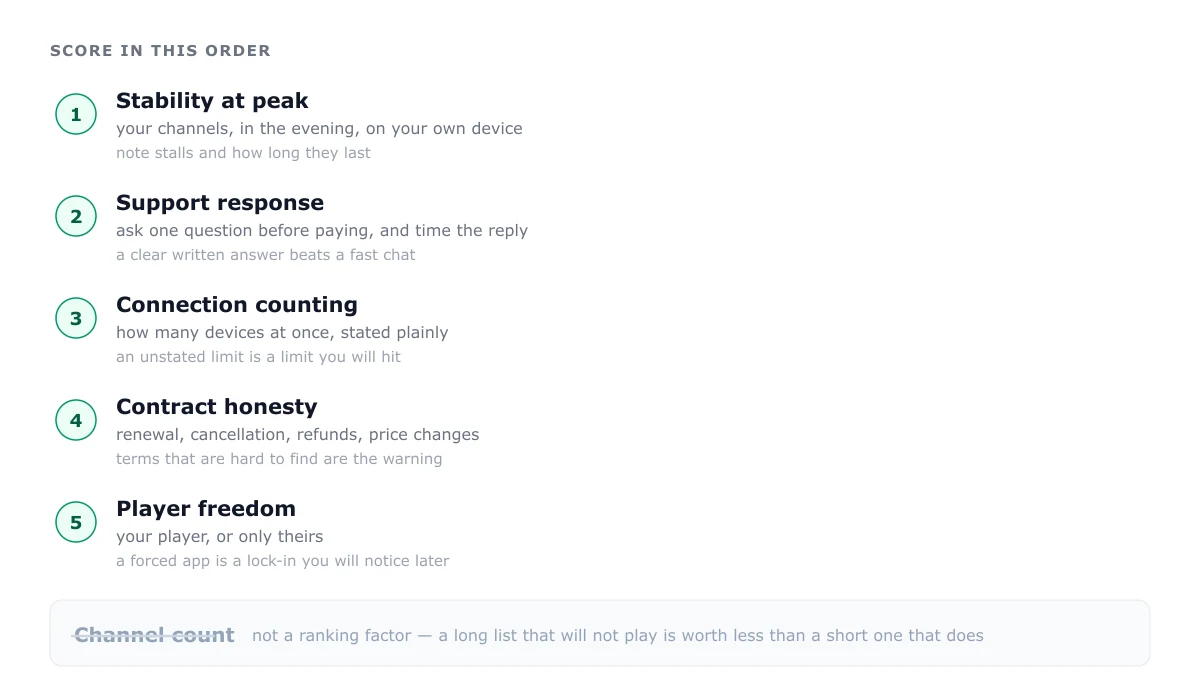
Score any service you consider against these five points. Give each one a rating that matches your own priorities, and write the reason down.
- Stability at peak times. Watch your channels in the evening, not only during a quick morning test. Note any stalls or freezes.
- Support response. Send a question before you pay, and time the reply. A clear answer in writing matters more than a fast chat reply.
- How connections are counted. Check how many devices can stream at once, and whether that limit is stated plainly.
- Contract honesty. Check the terms for renewal, cancellation, refunds and price changes. Terms that are hard to find or hard to read are a warning sign.
- Player freedom. Check whether the service works with the player app you prefer, or forces you into one app.
Channel count is not on this list on purpose. A long channel list that does not play is worth less than a shorter list that works reliably on your device.
What to test in 24 hours
Before you commit to a longer plan, run a short test:
- Set up the service on the device you will use every day.
- Watch the channels you care about at the time you usually watch.
- Check for stalls during peak hours, and note how long they last.
- Ask one support question in writing, and time the reply.
- Read the terms and the refund route before you pay.
If a service will not let you test it, or will not answer a simple question, that tells you something about how it will treat you later.
Price versus usable months
The cheapest monthly price can cost more in practice. A plan that stalls every evening gives you fewer usable months than its price suggests. Work out the cost per usable month, not the cost per listed month, and count the months when the service worked as promised. The cost guide explains how to make that calculation.
What to avoid
Some signs should end the search for any service, whatever its price:
- No company name, terms or refund route stated before you pay.
- Payment only by a method that cannot be reversed.
- A channel count that cannot be real at the price offered.
- Support that exists only through a chat app.
The scam guide sets out these patterns in more detail.
Legal position and privacy
A service can meet every criterion above and still be unlicensed, which is a separate question. Whether a service is licensed affects your legal position as a viewer, and the legal guide explains it. Privacy is another separate question, and the VPN guide covers what a VPN does and does not change.
Start with the fundamentals
If you are new to IPTV, read the basics before you compare services. The what IPTV is guide explains how the service is delivered, and the how to choose guide walks through the full selection process. For a trial, the free trials guide explains what a trial can and cannot tell you.
Frequently asked questions
What is the best IPTV service?
There is no single answer for every household. The best service is the one that carries the channels you need, plays reliably on your device and connection, has honest terms, and offers a test you can run before committing.
Why does this site not publish a list of the best IPTV services?
We have not yet tested the services ourselves, and we will not publish scores or rankings we cannot back up. Until we do, this page sets out how to judge any service, so you can test them yourself.
How do I test an IPTV service before paying?
Check the terms, ask for a trial, and test the channels you watch on the device you use, at the time of day you watch. Measure stability during peak hours, not only in the first few minutes.
Does a higher price mean a better IPTV service?
Not necessarily. Price alone does not show stability, support or honest terms. Compare the cost per usable month, and check the other criteria before deciding.