IPTV is not a grey area as a technology. It is how broadcasters, telecom operators and public service media have delivered television for years. The legal question is entirely about content rights, and it applies to the specific service rather than to the delivery method.
That distinction is worth being precise about, because almost every IPTV article conflates the two — usually to avoid a direct answer.
What is unambiguously lawful
- A licensed IPTV service. One that holds retransmission agreements for the channels it carries in the territories it serves.
- Broadcaster apps. iPlayer, Peacock, Zattoo, and similar services that deliver their own licensed content over IP.
- The protocol itself. M3U, HLS, XMLTV and Xtream-style APIs are neutral formats.
- Player software. A media player has no view of licensing; it plays what it is given.
What is generally unlawful
- Retransmission without rights. A service carrying channels it has no agreement to distribute, regardless of how it is marketed.
- Redistribution of a subscription. Sharing credentials outside the provider’s terms, which usually also breaches the contract.
- Public playlists of paid channels. Circulating M3U lists of premium feeds is the clearest case of all.
If a service offers an enormous channel count including premium sports and film channels from multiple countries for a price far below any legitimate broadcaster, the licences for that content cannot be covered by the subscription. That is not a moral judgement; it is arithmetic.
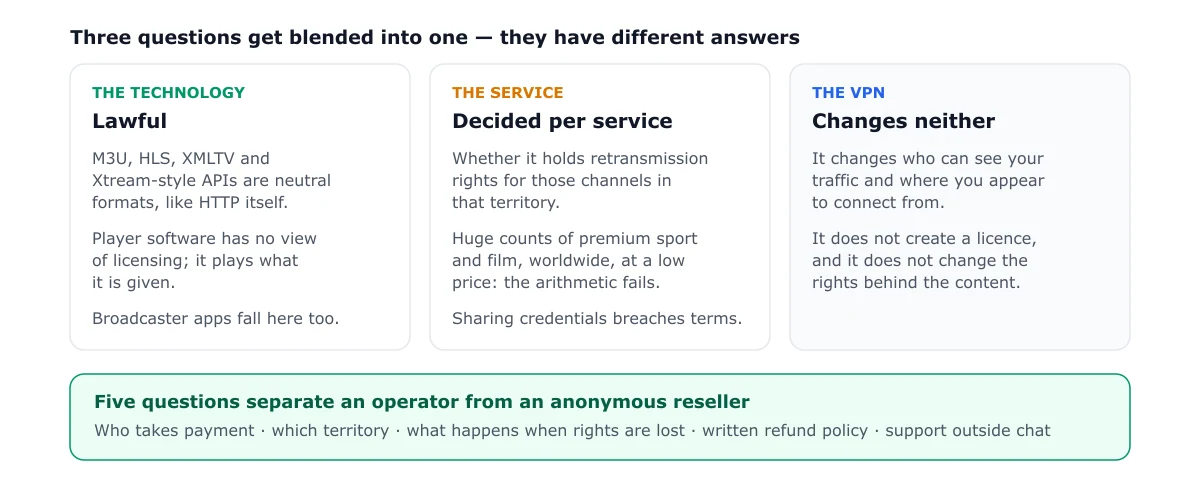
Five questions that reveal which one you have
- Who takes the payment? A named company, or a chat handle? Card processors require an identifiable merchant, which is why anonymous services push crypto and gift cards.
- Which territory is the service licensed for? A specific answer is a signal. “Worldwide” for premium rights is not credible.
- What happens if a channel is removed for rights reasons? Licensed services have an answer, because it happens to them routinely.
- Is there a written refund and cancellation policy? Rights-holding businesses operate like businesses.
- Does support exist outside a chat app? A paper trail matters when a dispute arises.
None of these proves licensing. Together they separate operators from anonymous resellers, which is the practical question most readers actually have. The selection guide turns them into a scoring sheet.
What the risk actually looks like for a viewer
Jurisdiction matters and this site cannot give legal advice. What can be said generally:
- Enforcement has focused primarily on operators and distributors, because that is where the commercial harm is.
- Users have faced notices and, in some jurisdictions, penalties, particularly where services were clearly unlawful.
- Payment and privacy exposure is real regardless of legality: unregulated services hold your email, payment identifiers and viewing data with no obligations about how they use them.
- Account loss is routine. Unlicensed services disappear, and prepaid annual plans vanish with them.
That last point is the practical argument that does not depend on the law at all: you are prepaying a business with no continuity obligation.
Why this site does not link to playlists
Because the licensing status of a playlist nobody can identify is unknowable, and because publishing one would make this site part of the distribution chain rather than a description of it.
We explain the formats — M3U, Xtream Codes, EPG — so that readers can configure a service they have chosen. Explaining a format is not the same as supplying content, and the distinction is the reason this site can discuss IPTV seriously.
A safer way to approach the category
- Start with a licensed service in your country, even if the channel list is smaller and the price higher.
- Prefer a broadcaster’s own app where it covers what you want to watch. It is the least ambiguous option available.
- Pay monthly while you evaluate anything, and use a payment method with recovery rights.
- Never share credentials, and never post a playlist URL publicly for troubleshooting.
- Keep expectations honest: a service that arrives with no paperwork, no territory statement and no refund policy is not a bargain, whatever the channel count says.
The short version
IPTV is legal. Retransmitting channels you do not have rights to is not. Everything in between is decided by the provider’s licensing and your local law — which is why the useful question is never “is IPTV legal?” but “is this service authorised to carry these channels here, and can it show me why?”
Frequently asked questions
Is IPTV legal in the US?
The delivery technology is legal. Whether a specific service is lawful depends on whether it is authorised to retransmit the channels it carries. Services that retransmit broadcast channels without permission have been the subject of enforcement action, and using one can carry risk. There is no blanket answer that covers every service.
Does a VPN make IPTV legal or illegal?
No. A VPN changes the network path, not the legal status of the service you are using. It is a privacy tool, not a compliance tool, and treating it as one is a common misconception.
How can I tell whether a provider is licensed?
Look for a named legal entity taking payment, a stated territory of operation, a published refund and cancellation policy, and a support channel with a paper trail. Providers that publish only channel counts and marketing claims have told you what they are.
Are free public playlists legal?
Almost never. Publicly circulated playlists generally contain retransmissions nobody has licensed for distribution. That is also why they break constantly: no one is maintaining the infrastructure behind them.