Choosing between IPTV, cable and satellite is mostly a question of three things: which channels and sport you want, how much contract you will accept, and what hardware you already own. The answer is not the same for every household, and for many people licensed cable or satellite remains the better option. This guide compares the three on the points that matter, so you can work out which suits your home.
The honest short answer
If you need premium live sport from one provider, and you want a predictable bill and a support line, licensed cable or satellite is often the simpler choice. If you already have a good internet connection, you want flexible contracts, and the channels you need are available through a licensed IPTV service, IPTV can work well. The short answer depends on your priorities, so the rest of this guide sets out the trade-offs.
How each method is delivered
- Cable sends television over a coaxial network run by the local provider. The service and its equipment are usually supplied as a bundle.
- Satellite receives signals from a dish on the roof. Installation needs a clear view of the sky, and the signal can be disrupted by heavy weather.
- IPTV sends television over your internet connection, as data. Its quality depends on your line, your router and the provider’s servers.
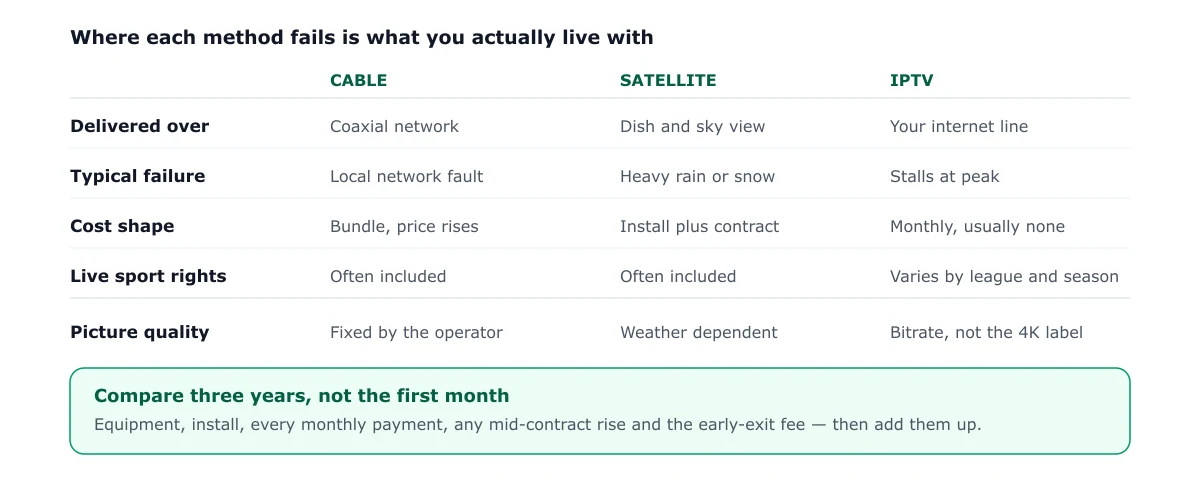
Because each method fails differently, the reliability question is really about which faults you are more likely to meet at home.
Cost over three years
The first month’s price can mislead, so compare the total over the length of a contract. Use your own quotes and fill in the table:
| Cost item | Cable | Satellite | IPTV |
|---|---|---|---|
| Equipment (box, dish, stick) | Enter your quote | Enter your quote | Enter your quote |
| Installation | Enter your quote | Enter your quote | Usually none, check |
| Monthly subscription, 36 months | Enter your quote | Enter your quote | Enter your quote |
| Price rises during the contract | Check terms | Check terms | Check terms |
| Early-exit fee | Check terms | Check terms | Check terms |
| Three-year total | Add up | Add up | Add up |
Check how the price changes after any introductory period, and whether an early-exit fee applies. Many bundles look cheap in month one and cost more by month twenty-four. Keep every quote in writing so you can compare like with like.
Reliability and weather
Satellite is affected by heavy rain and snow, which can break the picture for a short time. Cable depends on the local network, which can fail in a storm or during maintenance. IPTV depends on your internet line, so a slow or unstable connection will show up as stalls and buffering. The question to ask is which fault you are more likely to meet at your address. If your internet line is already unreliable, IPTV is more likely to suffer. If your dish has a clear view of the sky, satellite is often steady.
Channel selection and rights
Live sport is the usual deciding factor. Broadcast rights are sold by country and often by season, and a service that carries one league this year may not carry it next year. Licensed cable and satellite packages often include the rights you care about, and they can tell you in writing which channels you get. Check the channel list for the specific sport you watch before you choose any option.
Picture quality: bitrate and frame rate, not the 4K label
A 4K label does not guarantee a sharp picture. The quality of a stream depends on its bitrate, which is the amount of data sent each second, and on its frame rate. Two services can both claim 4K while one looks far better. Compare the stream you actually watch, on the device you use, rather than the label on the box. The bandwidth guide sets out the connection speeds each quality needs, and the stream formats guide explains the formats in more detail.
Who should stay on cable or satellite
Stay with licensed cable or satellite if:
- You watch premium live sport that a licensed package includes.
- You want one provider for support, billing and equipment.
- Your internet connection is unreliable, or you have a data cap.
- You do not want to manage apps, playlists or devices yourself.
Who might consider IPTV
IPTV can suit you if:
- You already have a fast, stable internet connection with no restrictive cap.
- The channels you need are available through a licensed IPTV service.
- You are comfortable setting up and troubleshooting an app on your device.
- You have compared the three-year total and found it works for you.
This site does not recommend unlicensed services. Whether a service is licensed is a separate question from which method suits you, and the legal guide covers it in detail. Before you switch from cable, check your contract’s exit terms, confirm that a licensed replacement carries the channels you need, and test it. Do not cancel until the switch works.
For a plain explanation of how IPTV is delivered, see what IPTV is. For the costs of an IPTV plan, see the cost guide.
Frequently asked questions
Is IPTV cheaper than cable?
It can be, but only once you add up the whole cost: hardware, subscription, installation and any early-exit fee. Work out the three-year total for each option using your own quotes, rather than relying on the first month's price.
Is IPTV more reliable than cable or satellite?
Not in general. Each method fails in different ways. Satellite can be affected by weather. Cable depends on the local network. IPTV depends on your internet connection and the provider's servers. Compare the fault patterns that matter for your home.
Which is better for live sport, IPTV or cable?
For premium live sport, licensed cable and satellite packages often include the rights that matter to you. Check which channels you need before you choose, because rights differ by country and by season.
Should I cancel cable to switch to IPTV?
Only after you have checked your contract's exit terms, confirmed the channels you need are available through a licensed service, and tested the replacement. Do not cancel until the switch works.