IPTV scams are common because the product is easy to imitate. A seller can advertise thousands of channels, a low monthly price and a fast setup, and the buyer has no easy way to check any of it before paying. This guide sets out the patterns that recur, how to spot them before you pay, and what to do if you have already paid.
The five patterns
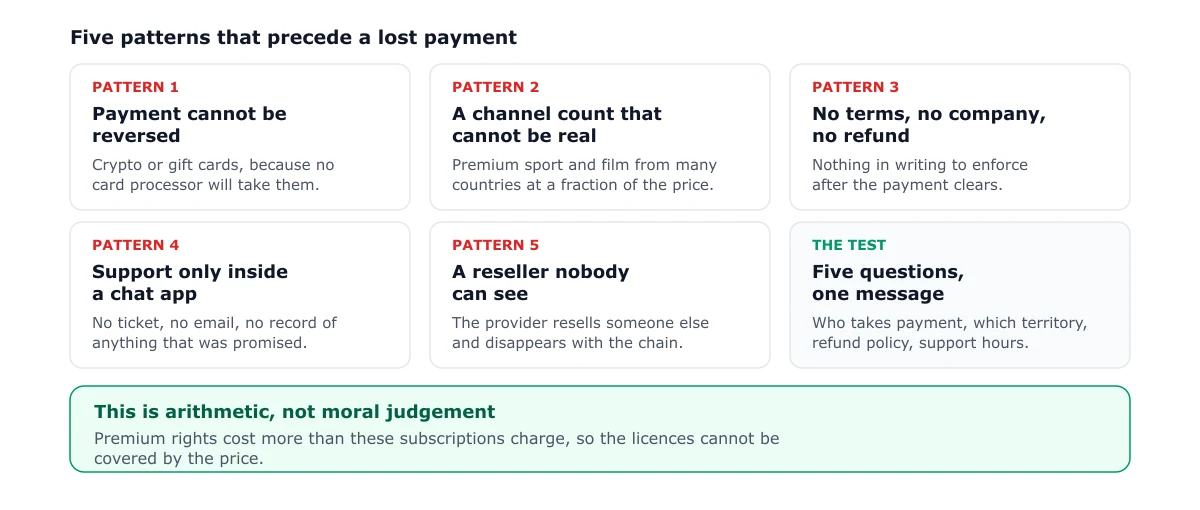
These are the warning signs that appear most often. None of them proves a scam alone. Several together should make you stop.
- The payment cannot be reversed.
- The channel count cannot be real.
- There are no terms, no company name and no refund route.
- Support exists only in a chat app.
- There is a reseller chain with no visible seller.
Pattern 1: a payment that cannot be reversed
Card payments usually give you a route to dispute a charge through your card issuer. Bank transfers, cryptocurrency and some gift-card payments are much harder to reverse. A seller who asks for one of these, and who will not take a card, is asking you to give up your main route to a refund. That alone is a reason to walk away.
Pattern 2: a channel count that cannot be real
Any service advertising tens of thousands of channels at a low monthly price is making a claim that does not hold up. Licensed broadcasters do not sell that much content for that price, and the channel list is often padded with duplicates or channels that do not play. This is a point about the arithmetic, not an accusation against any particular brand.
Pattern 3: no terms, no company name, no refund route
A legitimate service states who it is, what you are buying, what happens if it stops working, and how to get a refund. If you cannot find a company name, a set of terms, or any written refund position before you pay, you have no basis for a claim later.
Pattern 4: support that exists only in a chat app
Support through a messaging app with no published address, no help pages and no ticket system is hard to hold to account. Once the chat goes quiet, there is no one to complain to. Check whether the seller offers any other way to reach them, in writing, before you pay.
Pattern 5: a reseller chain with no visible seller
Some offers pass through several resellers before they reach you. If you cannot identify who runs the service you are paying, or the company that holds the terms, the chain makes accountability very hard. Ask who the provider is, and whether they will put their name and terms in writing.
Check the legal position too
A service can show several of these signs and still be unlicensed, which is a different risk. Whether a service is licensed affects your legal position as a viewer, and the legal guide explains that question. This page covers the fraud risk. The two can overlap, but they are separate checks.
What to do if you have already paid
Act quickly, because reversal routes have time limits.
- Contact your bank or card issuer now. Explain that you paid for a service that did not deliver, and ask about a dispute or chargeback.
- Keep everything. Save receipts, messages, the seller’s name and contact details, and screenshots of the offer.
- Do not send more money to recover the first payment. A follow-up request for a fee to release a refund is a common second scam.
- Report it to the consumer authority in your country. The reports help others who are targeted by the same seller.
What a legitimate service looks like
A service you can trust states its company name and address, publishes terms that include a refund route, accepts a card or other traceable payment, and gives support in more than one place. It also does not promise an impossible channel count or price. If a service meets these points, that does not prove it is licensed, but it does mean you can hold it to its word.
For the basics of how IPTV is delivered, see what IPTV is. If you are concerned about your privacy while using any service, the VPN guide covers what a VPN does and does not change.
Frequently asked questions
How do I know if an IPTV provider is a scam?
No single sign proves a scam, but several together are a strong warning. Look for an irreversible payment method, no company name or terms, a channel count that seems impossible, and support that exists only in a chat app. Check two or three of these before you pay.
Can I get my money back from an IPTV scam?
It depends on how you paid. Card payments may be disputed through your card issuer, and that route is often quickest. Payments by bank transfer or cryptocurrency are much harder to reverse. Contact your bank or card issuer as soon as you suspect a problem.
Is a cheap IPTV subscription always a scam?
Not always, but a very low price for a very large service is a warning sign. Price alone does not prove a service is a scam, and it does not prove it is legitimate. Check the other signs before you decide.