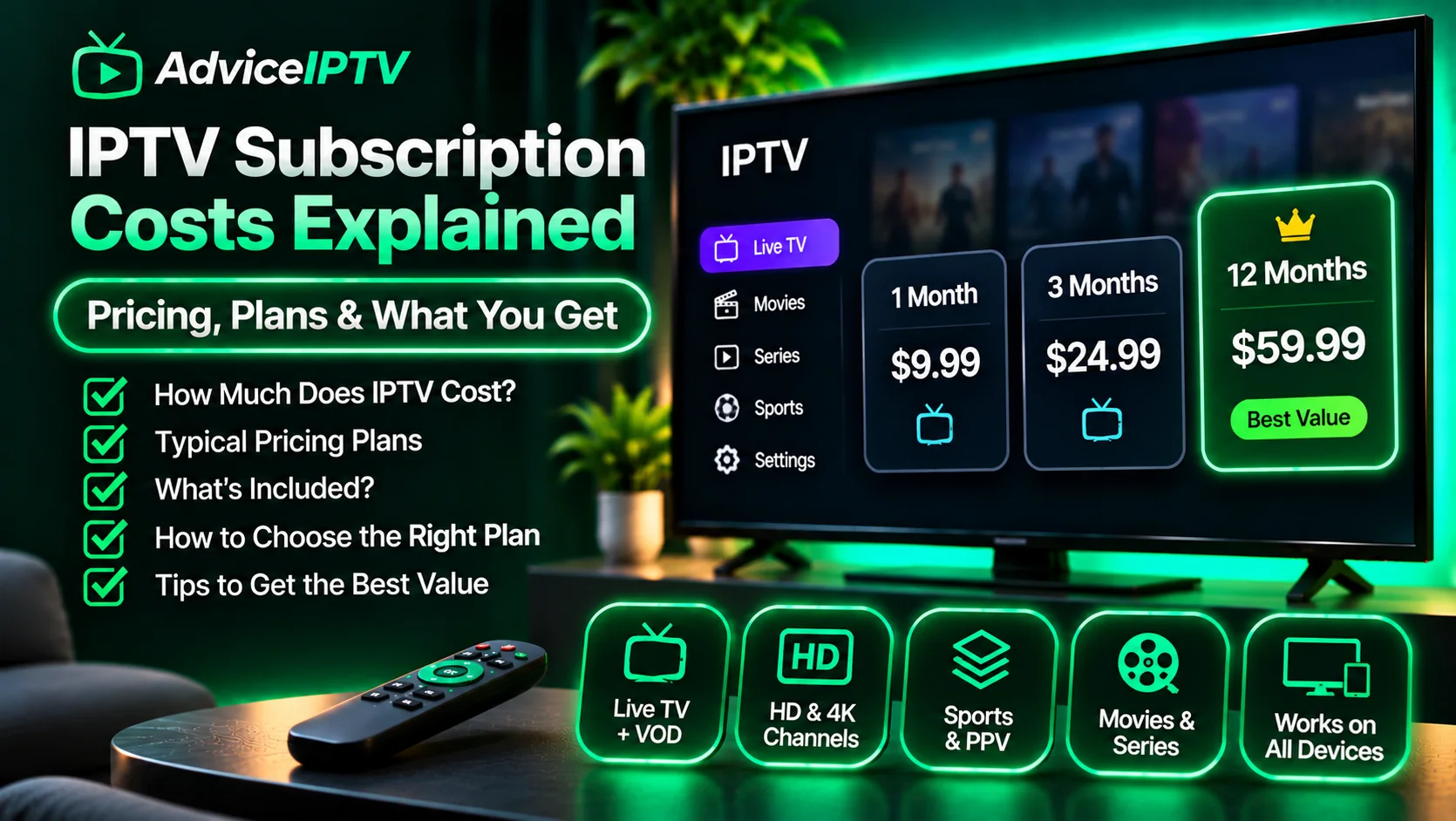
The IPTV pricing page is usually the least informative page on a provider’s site. It shows a big monthly number, a strikethrough annual number, and a configurator. What it rarely shows is the number that decides whether the purchase was sensible: cost per usable month.
That figure is simple to calculate and it changes the ranking of every plan.
The four cycles, costed honestly
| Cycle | Typical band | Per-month equivalent | Exposure if it fails |
|---|---|---|---|
| Monthly | $12 – $25 | $12 – $25 | One month |
| Quarterly | $30 – $55 | $10 – $18 | Three months |
| Six months | $55 – $85 | $9 – $14 | Six months |
| Annual | $100 – $160 | $8 – $13 | Twelve months |
On paper the annual plan wins every time. In practice, the comparison only holds if the service is usable for the whole period.
The arithmetic nobody publishes
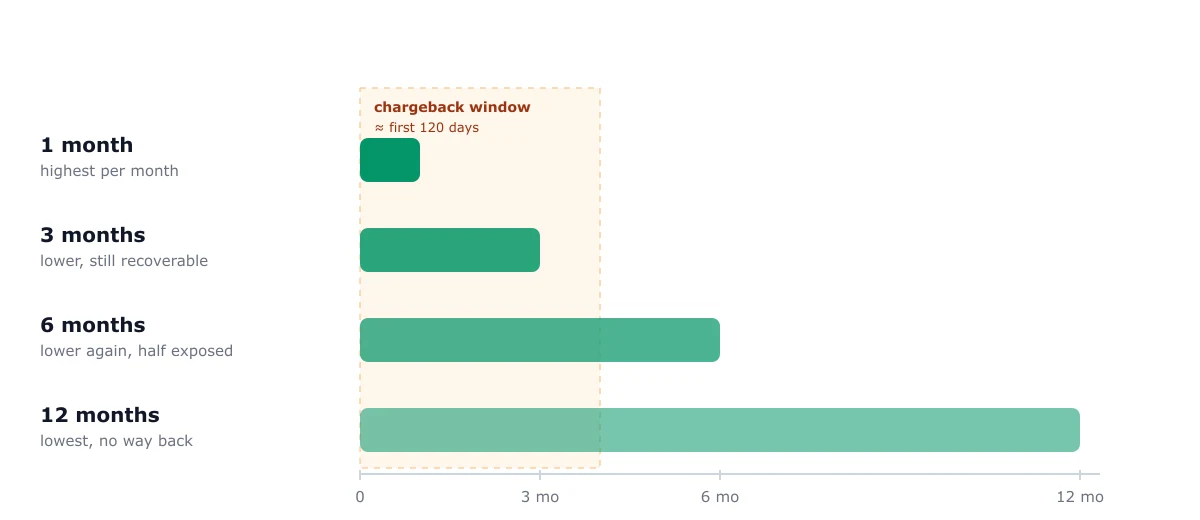
Take a $120 annual plan that becomes unusable after three months. You paid $120 and received three months of service: $40 per usable month. Three separate monthly plans at $15 would have cost $45 and left you free to switch.
That is the entire argument for starting monthly. The annual discount is compensation for risk — and until you have measured the risk, you are being paid to take a bet you cannot price.
Where the real cost hides
Connections
The base price almost always assumes one screen. A household with two televisions and two phones is not a one-connection household, and the multi-connection tier can add 40–80% to the price.
Ask specifically: does a casting phone consume a connection? The answer varies by provider, and it is the difference between a plan that suits your household and one that fails every Sunday.
The EPG and catch-up
Some providers include a full electronic programme guide; others charge for it, or supply a partial guide with gaps. A guide is not a luxury: without one, browsing forty thousand channels is unusable. Confirm inclusion before paying, not after.
Renewal behaviour
The most common avoidable charge in this market is auto-renewal switched on by default. If you take a monthly plan to test, check the renewal setting the same day. Providers that require a cancellation email three days before renewal are designing a friction point, not a billing system.
Payment method risk
Card payments offer chargeback rights; crypto and gift cards do not. That difference is worth a small price premium if the provider is new to you. Paying by a method with no recovery path is itself a cost, paid only if something goes wrong.
What a fair plan looks like
A defensible offer has these properties:
- Per-month price published for every cycle, without a configurator.
- Connections counted in plain language, including casting devices.
- EPG inclusion stated on the pricing page.
- Renewal date and auto-renewal state visible in the account area.
- Refund window of at least 48 hours, in writing.
- A trial long enough to cover a peak evening.
Providers that publish all six are rare, and their prices are usually mid-market rather than cheapest. That is not a coincidence: the cheapest offers in this category are cheap because something was removed, and it is usually support.
Should you ever pay annually?
Yes — under a specific condition. Pay annually only when both of these are true:
- You have run a monthly cycle for at least one full month.
- You have tested a live sports event or a peak-hour window on your own connection, on the device you actually watch.
If either is missing, the annual plan is a bet on infrastructure you have never seen under load. The discount is typically 30–45%; a failed year costs 100% of the price and all of the time.
Budgeting for the whole setup
The subscription is not the only cost, though it is usually the smallest after the first year.
| Item | One-off or recurring | Typical cost |
|---|---|---|
| Streaming device | One-off | $30 – $180 |
| Player app (premium tier) | One-off or annual | $0 – $35/yr |
| Subscription | Recurring | $100 – $300/yr |
| VPN (if used) | Recurring | $30 – $100/yr |
A $35 Fire TV Stick and a $12 monthly subscription is a complete, legitimate setup for under $50 to start. Anything more expensive should be justified by a specific need — 4K decoding, multi-room, or a platform with a better player ecosystem.
The decision, in one line
Start monthly, test at peak, and only convert to annual once the service has earned it. Our selection checklist covers what to check during that first month, and the free trial guide explains how to make the test itself meaningful.
Frequently asked questions
Why do IPTV prices vary so much between providers?
Because cost structures differ enormously. A provider running its own infrastructure and support staff has fixed costs a reseller does not, and a reseller's price can be low precisely because it carries no support obligation. Price differences are often a signal about support capacity rather than about content.
Is it cheaper to buy multiple connections at once?
Usually yes, but check how connections are counted. Some providers count a casting phone as a connection, some count by household, and some allow unlimited devices on one connection with a simultaneous-stream cap. The headline '5 connections' means different things on different sites.
How long should a refund window be?
At least 48 hours from activation, honoured without requiring you to prove a fault. If the window is shorter than the trial period, the trial is effectively your only protection — which is fine, as long as you test during peak hours.
Do annual plans ever make sense?
Yes, after a stable monthly cycle and at least one live sports event on your own connection. At that point the discount is compensating you for a risk you have already measured, rather than asking you to bet on an unknown.