A free trial sounds like the ideal way to evaluate an IPTV service. In practice, most people spend theirs clicking through channel lists and conclude something meaningless, such as “the picture looks good.”
That is a demo, not a test. A test has a hypothesis, a timing window, and a written result.
Why timing matters more than duration
IPTV servers do not fail evenly. They fail under contention, which means the hours when the largest number of subscribers are watching the same feed: evening prime time, and especially live sport.
A 72-hour trial that runs Monday to Wednesday proves almost nothing about Saturday at 20:00. A 4-hour trial during a major match is far more informative.
So the first question about any trial is not “how long?” but “when can I start it?” If a provider only issues trials on weekday mornings, that is a statement about their load profile.
The three checks worth running
1. Live playback on the channel you actually watch
Not the flagship 4K demo channel. The channel you will watch most — a regional news channel, a specific sports network, a general entertainment feed.
Watch it for ten uninterrupted minutes. Note:
- Time from selecting the channel to the first frame.
- Any stutter, and whether it resolves or escalates.
- Whether audio stays in sync over the full ten minutes.
Ten minutes matters because decoder and buffer problems often take several minutes to surface. A thirty-second glance hides exactly the failures that ruin an evening.
2. Channel-change latency
IPTV players buffer, and buffers cost time. Change between five channels in sequence and count.
| Switch time | Verdict |
|---|---|
| Under 2 seconds | Excellent; behaves like a set-top box |
| 2 – 4 seconds | Normal for IPTV |
| 4 – 8 seconds | Tolerable, will annoy heavy zappers |
| Over 8 seconds | Buffer or server problem |
If switching is slow but playback is stable, the provider has chosen a large buffer. That is a legitimate design trade-off, not a fault — but you should know it before you commit.
3. EPG population
Load the guide and time how long it takes to populate, then check for gaps. A guide missing half its entries makes a 40,000-channel service unusable, because browsing without a schedule is just scrolling.
Count how many of your twenty target channels have correct programme data. Under 80% is a problem.
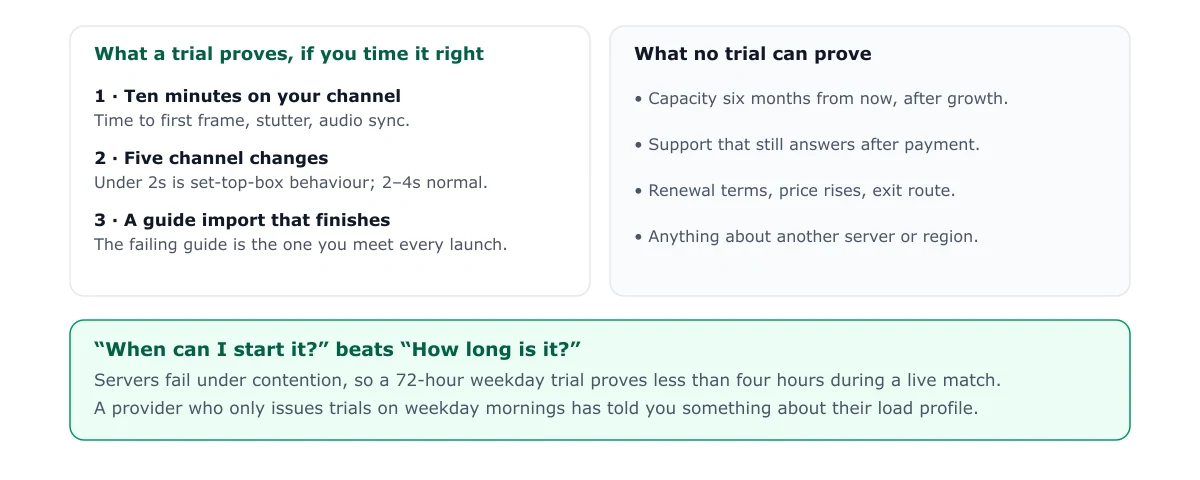
What a trial cannot prove
- Long-term reliability. One evening is a sample of one.
- Support quality under pressure. Trial tickets often get priority treatment.
- Whether the service will exist in a year. Nothing proves that.
- Legality. A trial tells you nothing about licensing; that comes from the provider’s disclosures.
That last point is worth repeating because trials are sometimes framed as reassurance. A working stream is not evidence of authorisation.
Trial terms that should concern you
- Card required, cancellation by email only. A funnel with a manual exit.
- Auto-renewal at full price, disclosed in small print below the trial button.
- No written refund window if the renewal charges and the service fails.
- Credentials delivered by chat message only, with no email record.
- Instructions to install a modified player from a file host rather than the official source.
The last two are about security as much as billing. Sideloading a legitimate player from its official repository is routine on Fire TV; installing a repackaged build from an anonymous link is how devices acquire unwanted software.
Turn the trial into a scorecard
Keep it simple. Before the trial, write down five to eight channels you actually want, then fill this in during the test:
| Field | Your note |
|---|---|
| Trial date and time window | Saturday 19:30 – 22:00 |
| Channels present in HD | 7 of 8 |
| Start-to-first-frame | ~3s |
| Channel-change average | ~4s |
| EPG coverage of target channels | 8 of 8, one programme gap |
| Playback faults | One 2s stutter at 20:05, recovered |
| Support response | 41 minutes, specific answer |
| Cancellation terms | No card taken |
Two trials scored this way give you a decision you can defend, rather than an impression you cannot quite remember. That is precisely the process described in the selection guide, and it is how the pricing trade-offs become decidable.
If the trial fails
Distinguish provider failure from local failure before you blame the service. A stutter that affects one channel is usually the source; a stutter that affects every channel and every device is usually your network.
Check in this order: wired connection instead of Wi-Fi, a different player, then a different device. If all three change nothing and the fault persists across multiple channels, you have a provider problem and the trial has done its job. Our buffering guide walks through the same order with the specific fixes at each step.
Frequently asked questions
How long should an IPTV trial be?
Long enough to include one peak evening. A 24-hour trial that lands on a Tuesday afternoon is worth less than a 6-hour trial during a Saturday match. If a provider only offers weekday trials, treat that as information about the hours their servers are under load.
Do trials usually require a credit card?
Mixed. Some require a card and auto-enrol you in a paid plan at the end; others issue credentials by email without payment details. A trial that demands a card but offers no written cancellation window is a marketing funnel rather than a test.
What should I test first during a trial?
Live playback of the channel you care about most, for at least ten minutes. Then channel switching speed across five channels, then the EPG loading. Video on demand is the least informative test because it is the most forgiving technically.
Can a trial prove a provider is reliable?
It can disprove reliability quickly, and it can give modest positive evidence. One peak evening that holds is encouraging but not conclusive. Two peak evenings on different days is a much stronger signal.